
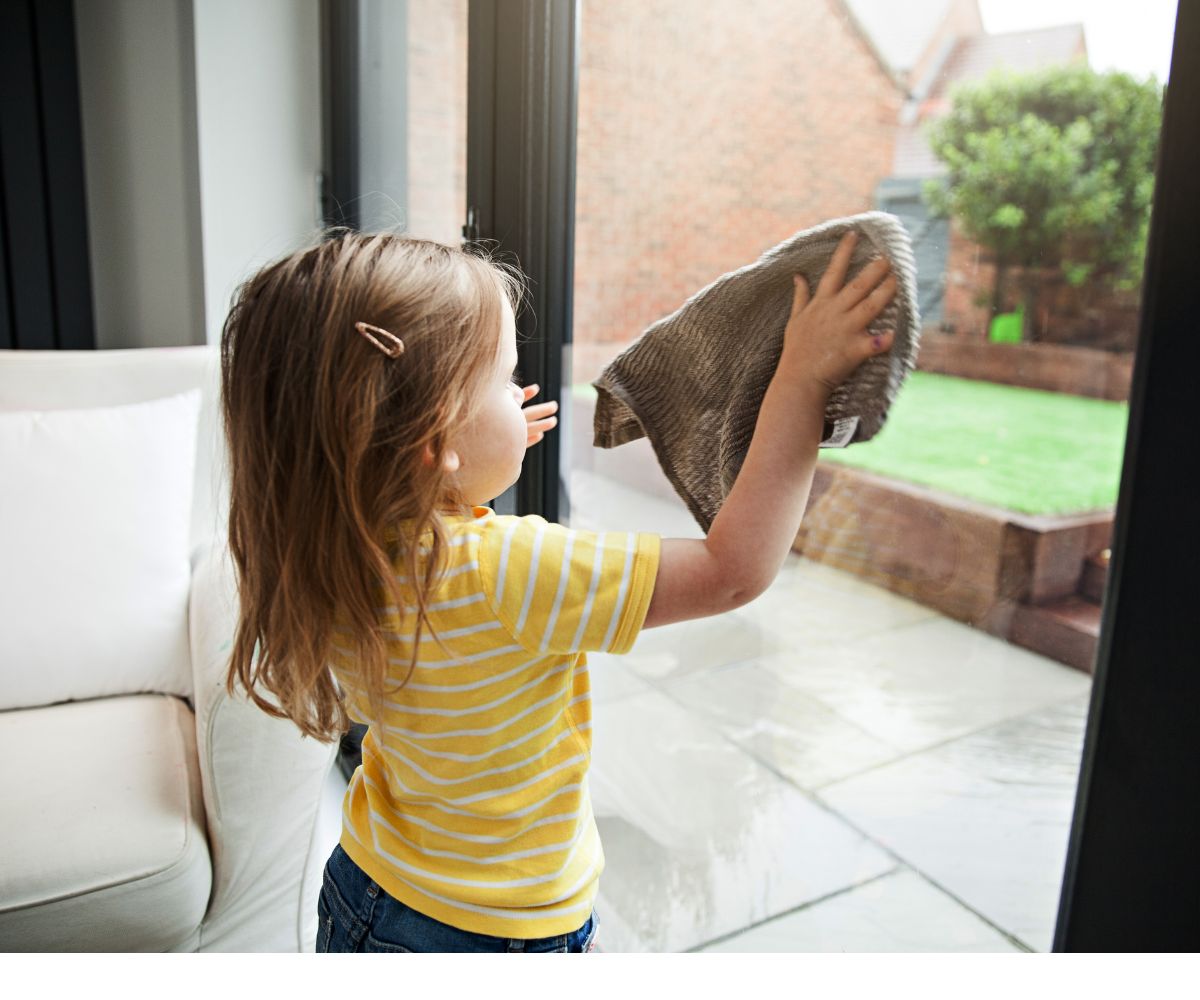

Raising children is a colossal responsibility.
It’s our duty to teach them (or see that they learn) everything they need to understand to be fully functioning adults.
We aren’t trying to raise stunted humans.
Now, I completely understand when people say it’s hard work teaching kids how to do household tasks. It takes so much more time to slow down and teach younger kids how to properly do chores. “It’s much faster if I just do it myself!”
True. Very true. But we are playing the long game here.
“Let us not grow weary of doing good, for in due season we will reap, if we do not give up.” Galatians 6:9
Like all people, children thrive with a sense of responsibility. A job well-done gives them a great sense of pride and accomplishment.
When a young person has little responsibilities they will resort to destructiveness in many forms.

Studies even show that people who had more age-appropriate chores as children grew up to lead more successful lives!
Check out this study from Harvard university.
When we treat chores as a punishment, the children will see them that way. But, when chores are simply a fact of life, something we can do cheerfully (even thankfully) the children will see they’re not that big of a deal.
Let’s talk about WHAT chores are appropriate for what ages.
This isn’t as simple as finding a free printable chore chart and running with it.
Those are great for inspiration, to be sure, but this is going to look different for every individual family.

A first-born 6-year-old with 5 younger siblings is going to be very adept (most likely) at many household responsibilities, while an only child 6-year-old may not be quite so familiar with as many household chores.
Children in rural homesteads will have different chores than children in a condo in a large city. The dynamics will just be different.
But, we can simplify this for our own family life, and come up with our own chore lists.
To start with: Decide WHAT needs to be accomplished in the home.
We (homemakers) should have a pretty good idea of the tasks necessary to keep the home afloat each week.
This is the best place to start, because we don’t want to waste our kids’ time (or ours) by creating a chore list that doesn’t even help our home.
Self chores
They should be tasked with tidying their own beds and personal space. That should be the first thing to get into a habit at a young age.

Children should be taught about personal hygiene and how to complete self-care tasks.
But it is super important for kids to also be expected to do family chores that will have a positive impact on the whole household. (Not just themselves)
The family is the priority
Now you can start to divide out the chores for the children.
I love using the “zone” cleaning method for myself, and do the same for my children. They each get a “zone” to keep clean, and every afternoon we all spend a few minutes cleaning up our zones.

One child is in charge of cleaning the main floor bathroom, one is in charge of tidying the living room, and one does the entryways.
*Pro tip: DO NOT redo their jobs after them. If they didn’t quite get it up to your standards, just LEAVE IT!
The last thing you want to do is squash their sense of accomplishment. Let them be proud and acknowledge the fact that they are still in training.
Of course, you will want to gently correct and encourage them along the way. Use your discretion.
For the Little Ones
You may want to consider letting young children dust, they love using socks on their hands.
Younger children are great at tidying shoes in an entryway (they’re closer to the ground!), they also excel at putting blankets away in the living room.
This is a great job for them, because it goes quickly and is safe.
*Small children should never be allowed to work around dangerous chemicals or scalding water without supervision.* duh.
Young children will be building good habits, and should be taught to put away toys before pulling out new toys. This will do wonders for keeping the home in order (less chores later!)

Making your master list!
Keep a list of simple tasks that your smaller children can learn to do that will actually help you out in your daily homemaking.
Keep this list in your phone or in your homemaking notebook. Just keep it handy so you can keep adding to your list.
Older children’s chores
Cleaning bathrooms is typically reserved for older children to do. They need to understand the order of the jobs, and will require much training. But, they CAN do it.
Kids are so smart!
It helps to hang up a notecard inside the cupboard door with a checklist for them to accomplish daily, along with a few things that can wait until the weekend.

Older children can have the strength to manage a vacuum, broom, mop, and take out garbages. Some of these tasks simply require the dexterity (and muscles) of slightly older kids.
When you’re teaching a new chore to children, remember to be patient and kind.
It would be absolutely unfair to set a child in a disastrous playroom that looks like a hurricane wreckage zone and say “PICK THIS MESS UP!” when they’ve never been expected to clean up before.
They need to be taught (patiently) how to accomplish tasks without getting completely overwhelmed.
Give them clear guidance and make sure you check on them often as they are working it out. “Don’t expect what you don’t inspect.”

Even when a child has been successfully working out a chore for months and months, you will want to pop in and watch them do it sometimes.
You may be surprised by their lack of work ethic or poor habits! They may just need a bit of positive reinforcement and correction.
In my previous post *Teaching kids to cook* we talked extensively about kids and kitchen chores, so we won’t go into that much here.

However, if kids are eating they should be helping to clean dishes and prepare food (at least somewhat).
Prioritizing chores
Now, we have established that kids should be helping with the responsibility of chores, but let’s talk about the dynamics.
Some children (even elementary school children) will have loads of extracurricular activities. What about teens that are working part-time jobs?
These can all be great things (in moderation), but they shouldn’t take precedence over the home.

Be sure you remind the child that they have a responsibility to the home and family members first, and their sports team comes second.
Their chore can be done ahead of time, if necessary, so they can still be important contributors to the family.
SHOULD WE GIVE FINANCIAL INCENTIVES?
The big question of the day.
Giving some pocket money is a great way to be able to teach some financial responsibilities. The tangible results of their efforts will be undeniable.
You may just find that giving an allowance is an excellent incentive for the children to complete chores cheerfully.
How about no?
There are many reasons NOT to give financial incentives.
#1- No adults get paid to maintain a home. This will teach unrealistic expectations for them as they grow up into young adults and realize no one is going to pay them to do their own laundry or wash their own dishes.
#2 -This is just one more thing for you to manage (on top of teaching everyone how to properly do their chores). The children doing chores is supposed to (eventually) make your life easier.
#3 – The chore is the reward.
After everyone works together on the common goal of caring for the home, take a moment and have the kids admire their work. Tell them, “Isn’t it so nice when the house looks so cozy and peaceful?”
They will truly grow to appreciate it and will be willing to put in the effort to make it so.
I believe many children struggle with chaotic living environments, but don’t know how to verbalize how they are feeling.
Learning to appreciate a tidy, clean home is all part of becoming a confident adult.
Meeting in the middle.
You could do a salary type situation, where you offer a set amount for the children to receive on the regular basis as long as their responsibilities are satisfactorily completed.

OR you could let the children ask for paid jobs if they are trying to save some money for a particular purchase.
These could be larger jobs that are outside the realm of their normal chores. Painting projects, rearranging projects, vehicle maintenance, are all things that could fall into that category. Remember, this is supposed to make your life easier!
What you’re doing is so important.
Teaching valuable life skills to our children is of vital importance. If we’re not intentional, we will just do everything ourselves because it really is faster (at first) and we just want the tasks accomplished!
BUT, don’t forget that raising capable adults is even more important than having a tidy home.
Raising confident people that know what it takes to function in the real world is the true long term goal.
They must know that homemaking matters.

Hi, I’m Stephanie! I’m a Christian wife, mom of 5, homeschooler, and a technically trained chef. I love creating a simple, beautiful life with our sweet family.
I’m so glad you’re here!
Leave a Reply